
Baltimore County Public Records Access
Maryland law opens many indexes and filed instruments, but access depends on the record. Baltimore County deeds and plats are generally open. Property assessment data is public, although the consumer portal blocks owner-name searches. Court summaries omit sealed, shielded, expunged, juvenile, adoption, and other protected matters. Certified vital records require proof of eligibility. The table leads with the official keeper and the practical fallback when a web search is incomplete.
| Record group | Official keeper | Web route | Access path |
|---|---|---|---|
| Deeds, mortgages, liens | Circuit Court clerk | MdLandRec, coverage varies by series | Free account; clerk copies and certification |
| Plats | Clerk and State Archives | plats.net statewide images | Online image; certified copy from clerk |
| Court cases | Maryland Judiciary and clerk | Case Search summaries | Free index; courthouse file and copies |
| Parcel assessments and sales | Maryland SDAT | Address, account, or map search | Free web search or assessment-office terminal |
| Birth, death, marriage, divorce | MDH Vital Statistics and Archives | Historical indexes vary by series | Eligibility form, mail, appointment, or approved online order |
| Permits and code files | County Permits, Approvals and Inspections | Online tools where available | Inspection or agency PIA request |
| Custody and offender data | DPSCS or county Corrections | State locator and statutory registry | Online lookup; detention center or VINE fallback |
“Public” does not mean every field is exposed. Protected identifiers may be redacted, and the Driver’s Privacy Protection Act restricts motor-vehicle personal data. Maryland General Provisions title 4 also recognizes exemptions for personnel, medical, welfare, investigatory, and other records closed by law. A custodian should release separable nonexempt parts when redaction can protect the rest.
Baltimore County Land Records
The Clerk of the Circuit Court records local deeds, mortgages, releases, liens, powers of attorney, certain leases, and other title instruments. Online access takes an unusual route: the Maryland Judiciary and State Archives jointly supply MdLandRec, although the Baltimore County clerk remains the custodian. A free Archives account is required. Choose Baltimore County and an available index or series, then use the fields offered by that particular index.
The MdLandRec access screen shows the account gateway used before opening indexed land images.
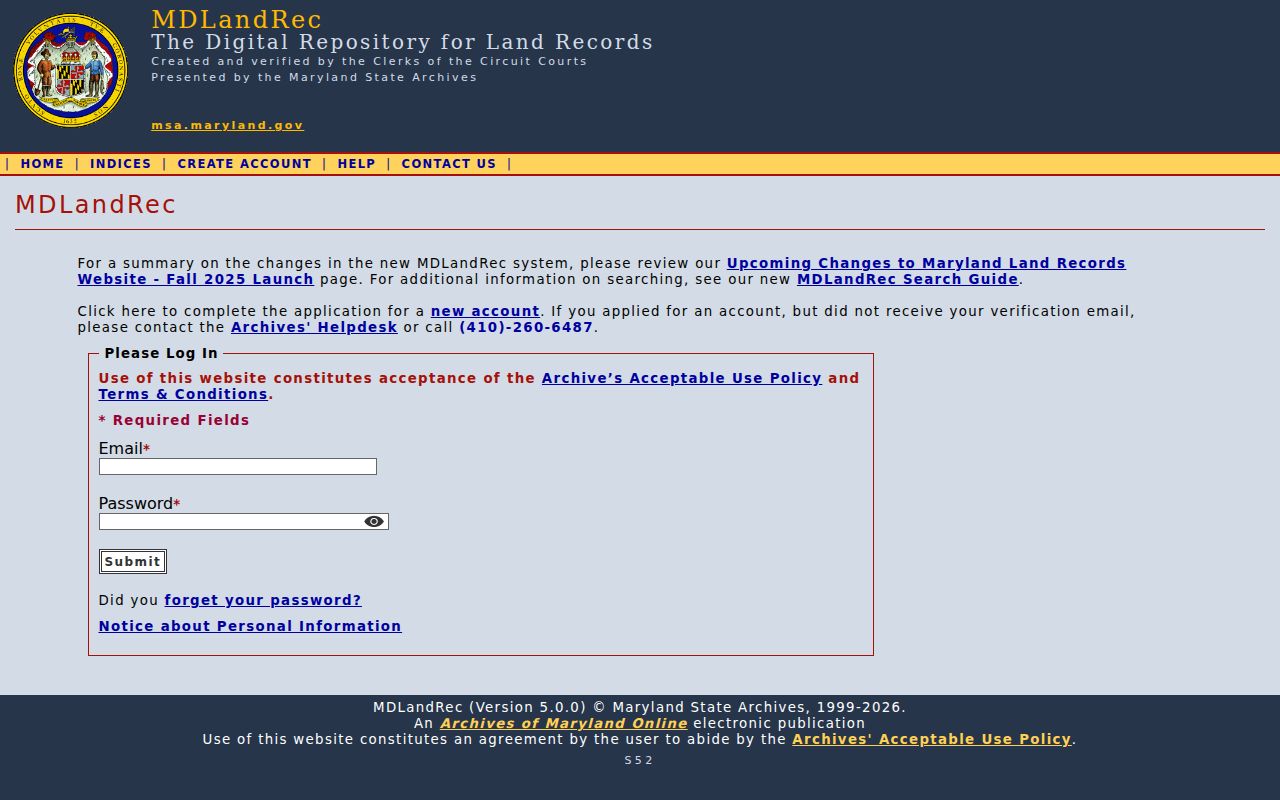
Once signed in, an index may offer grantor, grantee, instrument, liber and folio, or date tools. Grantor means a person conveying an interest; grantee means the person receiving it. Older index designs vary, so there is no single field set for more than three centuries of records.
| Land index field | How it helps | Limit |
|---|---|---|
| Grantor or grantee | Finds a party to an indexed instrument | Search spelling variants and a bounded date |
| Instrument type | Narrows deeds, liens, releases, or mortgages | Labels vary by series |
| Liber and folio | Opens a known book-and-page reference | Must first obtain the citation |
| Date | Controls broad name results | Recording date may differ from signing date |
Subdivision and condominium drawings are kept apart from deed images. The Maryland land plat service provides that image route.
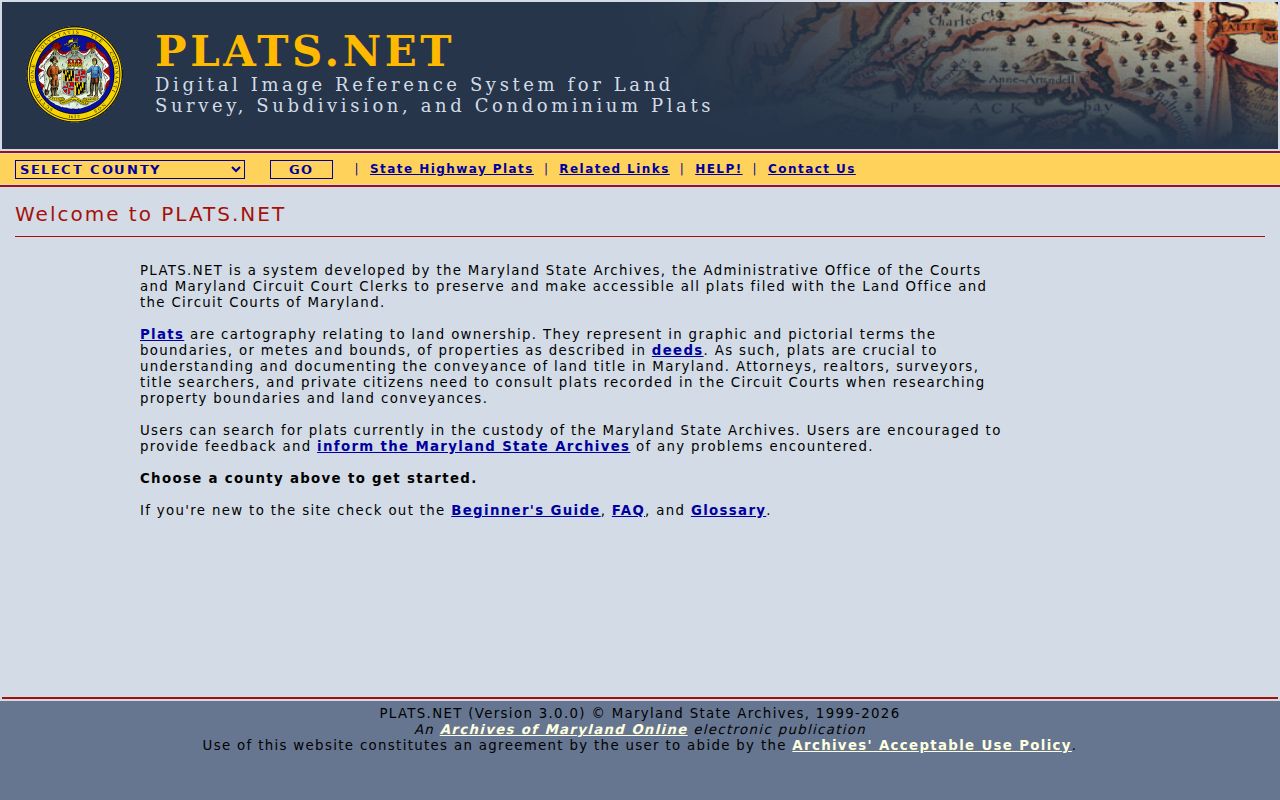
The separate plat screen matters when a deed cites a subdivision sheet or condominium plan rather than showing every boundary in the instrument.
Baltimore County Property Record Limits
Maryland SDAT’s Real Property Data Search covers about 2.5 million statewide accounts and sales, yet it is not an online owner directory. State rules prevent a consumer from asking the portal what land a named person owns. Start with a street address, Property Account Identifier, or map, grid, and parcel reference. A returned parcel card can show the owner name, mailing address, premises address, deed reference, transfer data, legal description, assessments, and building facts.
This distinction is useful. A mailing address may differ from the premises address and can show where tax notices go, but neither field proves current occupancy. If the web tool fails, SDAT assessment offices maintain public terminals. Baltimore County My Neighborhood adds address, parcel, district, and service geography, which is especially important when a Baltimore postal address may fall in independent Baltimore City.
Jurisdiction first. Confirm the parcel in Baltimore County My Neighborhood before sending a request, since Baltimore City has separate courts and land custodians.
Note: SDAT updates informational parcel data daily, but its screen is not a legal report and deleted accounts require an account-identifier search.
Baltimore County Court Record Indexes
Maryland Judiciary Case Search is a free summary index after terms acceptance and CAPTCHA. Person mode requires a last name, while first and middle names, party role, case type, court system, county, and filing dates can narrow results. A trailing percent sign supports limited partial-name searching. Results may list the case number, party role, court, case type, status, filing date, caption, events, and dispositions.
The Maryland court records gateway distinguishes the remote summary from the official court file.
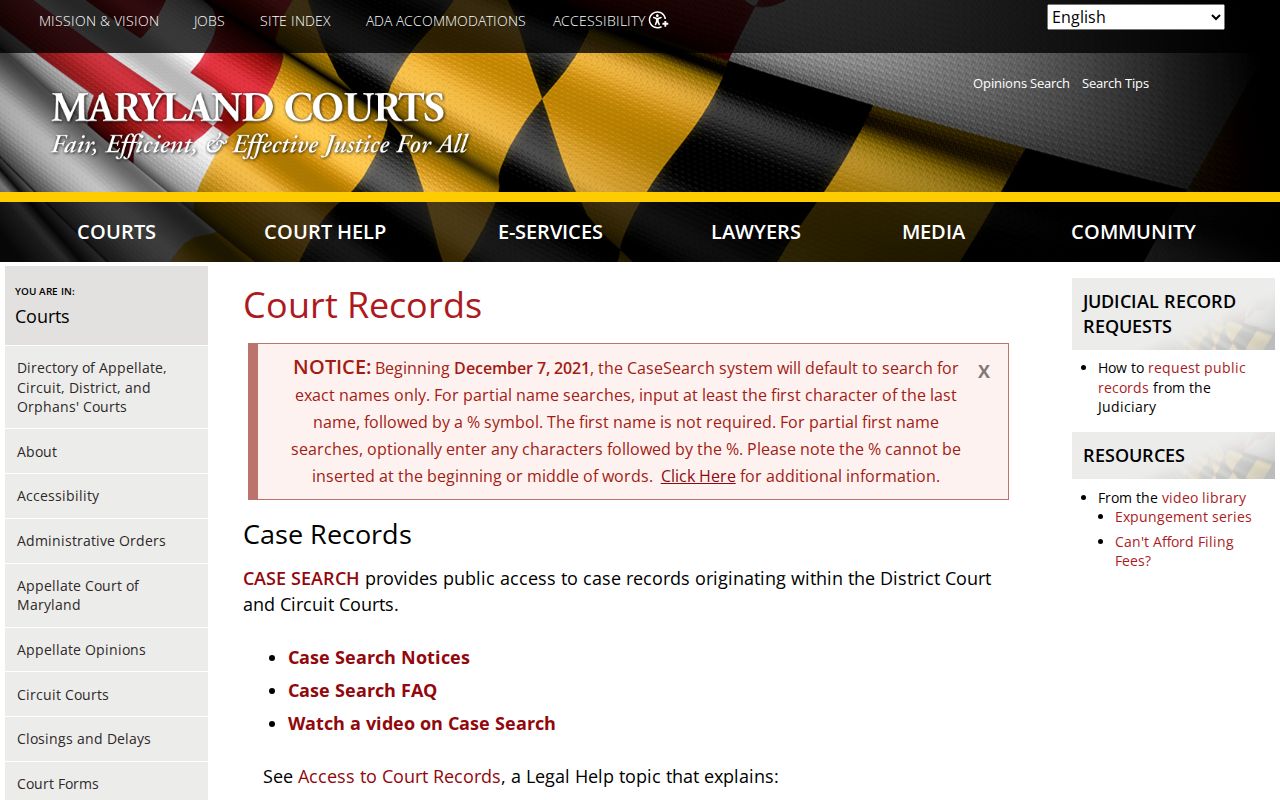
Baltimore County Circuit civil summaries begin June 1, 1995, and Circuit criminal coverage begins in June 1984. Remote results cap at 500. The courthouse counter may show more electronic detail, and the clerk can provide the complete public file. Some dismissed, acquitted, or nolle prosequi cases may be absent remotely, while a stet drops from remote display after three years.
The Circuit Court sits at 401 Bosley Avenue in Towson. District 8 has Towson, Essex, and Catonsville locations, and requests must follow the filing location. Historical or transferred cases may require the Maryland State Archives. Court access follows Judiciary rules rather than treating every file as an executive-agency PIA request.
Baltimore County Record Copy Costs
An index result identifies a filing. An image shows the underlying document. A certified copy adds the clerk’s authentication and is needed only when the receiving authority requires it. Circuit clerk copies cost $0.50 per page under the schedule effective October 1, 2025. Certification adds $5 plus copy charges, while exemplification adds $10 plus copies. A set of plats costs $5.
- Index
- A searchable pointer to a record, not the full filing.
- Certified copy
- A reproduction authenticated by the official keeper.
- Custodian
- The agency or clerk responsible for the requested record.
- Exemption
- A legal rule allowing or requiring information to be withheld.
PIA fees work differently. Agencies may charge actual search, preparation, and reproduction costs, but the first two hours of search and preparation are generally free under General Provisions §4-206. Ask for an estimate, seek inspection first, and narrow a broad date range before chargeable review begins.
Baltimore County Vital Record Access
Baltimore County Health Department does not issue certificates. Current certified orders go through the Maryland Division of Vital Records by appointment, mail, or an authorized online vendor. Birth and death certificates have a $10 state base fee; marriage and divorce verifications cost $12. Requesters must provide the record facts, identification, relationship or authority, and the required application materials.
State Government §9-1015 treats Archives births under 100 years and deaths under 10 years as restricted. Older Archives access varies by series. Marriage licenses and reports of absolute divorce or annulment are unrestricted Archives categories, but the eligibility rules still apply to certified Division of Vital Records copies. Birth county indexes cover 1898 through 1924 in several series, while older marriage holdings reach into the colonial period.
A divorce verification gives names, county, decree date, and action type. It is not the decree. Obtain the decree from the Circuit Court clerk. Current vital-record order routes and eligibility details belong to the Maryland Vital Statistics Administration.
Baltimore County Records Custodians
Three offices handle much of the local access work. The clerk manages court files, deeds, and licenses. SDAT manages parcel assessment data. The county permits department receives requests for its administrative files. Check the linked office before visiting because a state portal does not replace the local keeper’s copy service.
Circuit Court Land Records
401 Bosley Avenue, second floor
Towson, MD 21204
410-887-2651
Permits Records Desk
111 W. Chesapeake Avenue, Room 120
Towson, MD 21204
410-887-3353
Maryland PIA Rules for County Records
The Maryland Public Information Act in General Provisions title 4 allows any person to request state or local executive-agency records. Residence in Maryland is not required. The request must reasonably describe an existing record and reach the custodian. An agency need not conduct research, answer questions, or create a new compilation.
The Attorney General’s PIA explanation outlines response times, fees, exemptions, and review options.
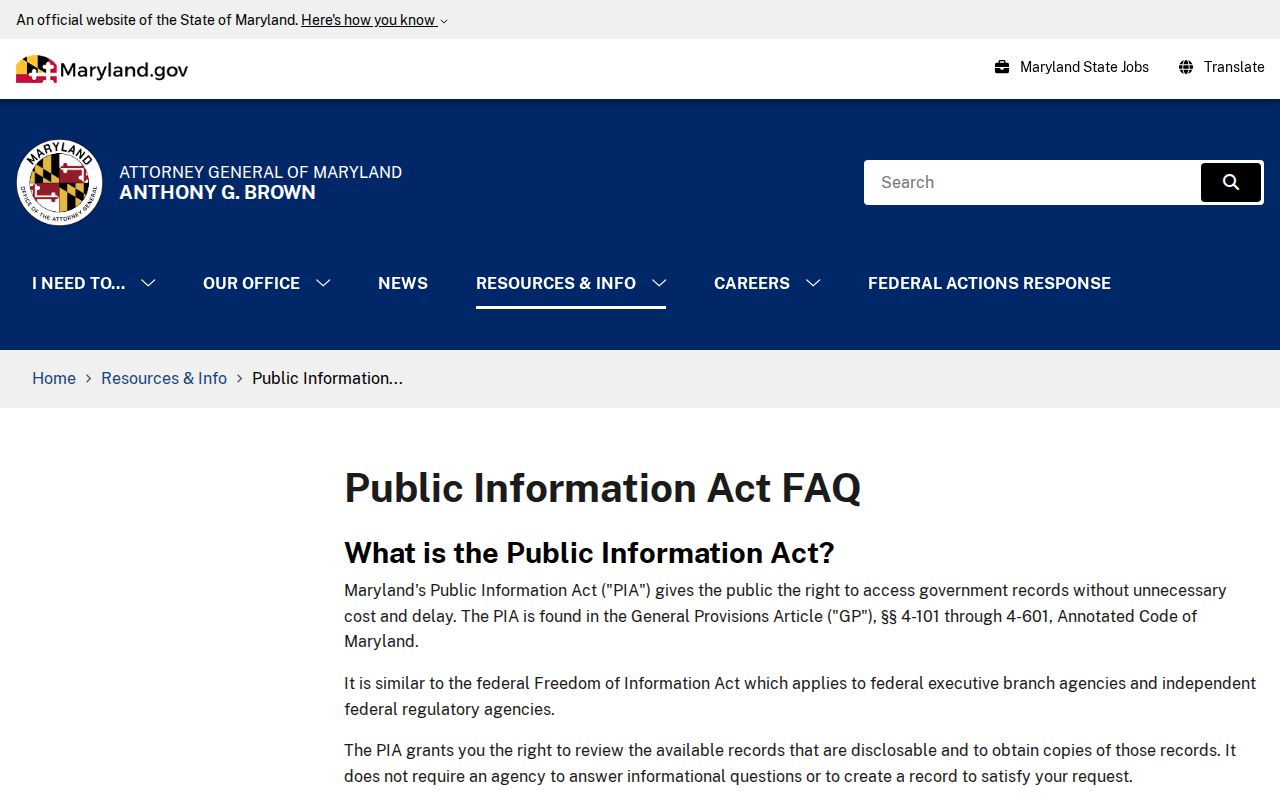
If production is not prompt and will take more than 10 working days, the custodian generally gives the reason, estimated completion date, and estimated fee. The ordinary outer response period is 30 days. A denial should state its legal basis and address whether nonexempt portions can be separated and released.
Request Baltimore County Public Records
A focused request moves faster than an “all records” demand. Name the record series, office, subject, spelling variants, date range, address, and any case, account, permit, or instrument number. State whether inspection, electronic files, ordinary paper copies, or certified copies are needed. County administrative files use PIA channels, but court files go to the clerk and vital certificates follow their own eligibility applications.
- Identify the office that created or keeps the file. Confirm Baltimore County jurisdiction before writing.
- Check the official index or portal. Save the case number, parcel account, liber and folio, or permit number it returns.
- Describe the existing record and a clear date range. Ask for the desired format and rolling production if the set is large.
- Request a cost estimate before chargeable work. Inspection can avoid copy expense, while certification should be ordered only when required.
- Keep a denial and its cited legal basis. Ask for redacted portions, then seek Ombudsman mediation, eligible PIA Compliance Board review, or judicial review.
Lawful use. Open records may support family history, estate work, consumer safety, and civic review. Maryland law prohibits stalking, harassment, threats, and malicious misuse of personal data.
When access stalls, the Maryland Public Access Ombudsman can mediate disputes. The PIA Compliance Board hears eligible fee complaints and specified violations. Circuit Court review also remains available. For a court case, use the Judiciary’s access process instead of routing the dispute as an ordinary county-agency request.
Baltimore County Records Beyond the Web
A blank web result is not proof that no record exists. The file may predate portal coverage, use a variant name, belong to Baltimore City, remain unindexed, sit at the Archives, or be hidden from remote view by a court rule. Courthouse kiosks can expose more public electronic detail than Case Search, and the clerk can inspect the paper or imaged file. SDAT also provides free assessment-office terminal access.
Older land media include bound volumes, microfilm, self-indexed books, and scanned series. Baltimore County land records begin in the colonial era, while Circuit Court volumes follow the 1851 court reorganization. Territory transferred to Baltimore City in 1918 may require county books before annexation and city block indexes afterward. The custodian changed even when the family or parcel did not move.
Write down the portal, date, filters, and spelling tested before contacting an office. That short search log helps staff identify the right series and prevents a second search from repeating the same dead end.
Note: An official index is a lead; read the filing or obtain the clerk’s copy before relying on identity, ownership, or case disposition.